
Content Strategy
Senior-led content strategy support that strengthens visibility, aligns messaging, and helps organizations create content with greater purpose, consistency, and authority.
The Public Relations Collective helps organizations build content strategies that support business goals, enhance leadership visibility, foster stakeholder alignment, and maintain market relevance. Our model gives clients direct access to experienced communications professionals who know how to shape content plans around what the business needs to say, who it needs to reach, and how that message should show up across channels over time.
Not every organization has the same content challenge. Some need a clearer editorial direction. Others need stronger executive content, better alignment across teams, or a more disciplined plan for creating content that supports visibility, trust, and growth. We build content strategies around the needs of the client, the realities of the market, and the goals of the business.
Content Strategy Services Built Around the Work

What We Deliver
The Public Relations Collective delivers content strategy support designed around the needs of the client, not the structure of a traditional agency. Our work combines senior judgment, specialized expertise, and the flexibility to match the right support to the right challenge.
Strategic Content Planning
We build content plans that connect business priorities to the topics, audiences, and channels that matter most. For the C-suite, strong planning turns content from a disconnected activity into a more useful strategic asset.
Editorial Direction
We shape the themes, storylines, and message priorities that should guide content over time. Clear editorial direction helps organizations avoid inconsistency and publish with greater purpose.
Executive Content Strategy
We help leaders show up with ideas, perspective, and visibility through content that supports credibility and authority. That matters because leadership content often shapes how the market understands both the executive and the organization.
Thought Leadership Content
We create content strategies that turn expertise into visible authority across articles, commentary, owned channels, and other thought leadership assets. For leadership teams, that means content supports trust and differentiation instead of filling space.

Stakeholder Content Alignment
We help organizations create content that reflects the needs of employees, customers, investors, partners, boards, franchisees, and other key audiences. Strong alignment matters because different audiences need different context, not the same generic message.
Messaging Integration
We connect content planning to broader brand messaging, positioning, and communications priorities. This gives organizations a more disciplined way to communicate the same core story across channels without sounding repetitive or fragmented.
Channel Strategy
We identify the right mix of owned, shared, leadership, and supporting channels for the content strategy. That helps the business create content where it can actually support visibility, understanding, and engagement.
Content for Growth or Change
We support organizations that need stronger content during expansion, leadership shifts, launches, repositioning, or business change. In these moments, content becomes a practical tool for clarity and confidence.
Ongoing Content Counsel
We provide strategic guidance for organizations that want a steadier, more sustainable approach to content over time. This gives leadership teams a clearer framework for deciding what to say, when to say it, and why it matters.
How Content Strategy Supports GEO and AI Visibility
Content strategy now does more than support websites, blogs, and campaigns. It also influences how clearly your organization is understood across search and AI-driven discovery.
When content is thin, inconsistent, or disconnected from the real questions your audiences are asking, search engines and AI systems have less useful material to interpret and reference. A strong content strategy creates stronger textual signals about who you are, what you do, what your leaders know, and which topics your brand should be associated with. That clarity helps reduce ambiguity across your digital footprint.
In practical terms, a strong content strategy can support GEO by improving topic ownership, strengthening entity clarity, aligning executive and brand signals, and making your most important pages more useful and more reference-worthy. The result is not just better content for human readers. It is also stronger source material for the systems increasingly shaping discovery and visibility.
Content Strategy Tactics
Content Audit
We assess your current content footprint to identify gaps, duplication, weak messaging, and missed opportunities.
Editorial Theme Development
We define the core themes and narratives your organization should consistently own.
Audience Content Mapping
We align content priorities with the needs of the audiences that matter most to the business.
Leadership Content Planning
We create a strategy for executive updates, thought leadership, and visible leadership communication.
Topic Cluster Development
We organize content around clear themes and supporting topics so authority builds more intentionally over time.
Messaging Alignment
We make sure content reflects the broader brand narrative, value proposition, and strategic priorities of the business.
Channel Planning
We identify where content should live and how it should be adapted across owned and supporting channels.
Editorial Calendar Development
We build a practical content calendar that supports consistency, timing, and stronger internal alignment.
Content for Change or Growth
We shape content strategies for organizations navigating launches, expansion, leadership changes, or market shifts.
Supporting Asset Development
We identify the supporting articles, FAQs, executive pieces, and stakeholder materials that make the strategy stronger.
Content Refresh and Refinement
We improve existing content so it stays relevant, more useful, and better aligned with business goals.
Ongoing Strategic Counsel
We provide continued guidance so content strategy stays disciplined, adaptive, and connected to the bigger picture.
How We Approach Content Strategy
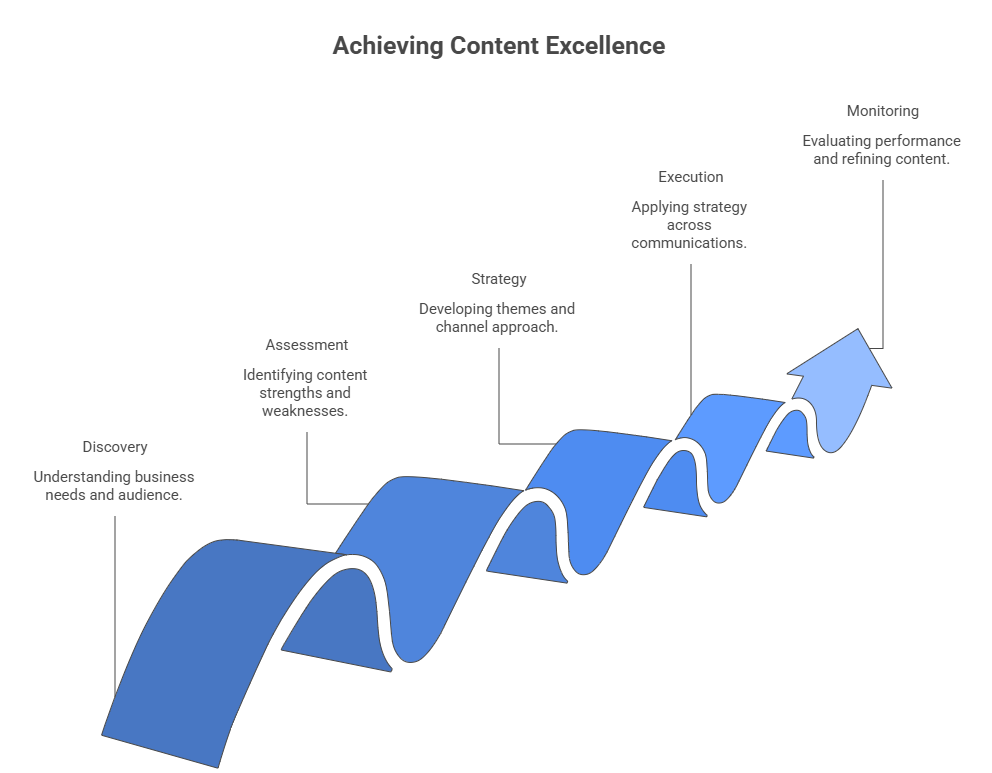
1. Discovery
We start by understanding your business, your audiences, your goals, and the content challenge in front of you.
2. Assessment and Direction
We identify where the current content is strong, where it breaks down, and what needs to be clarified or strengthened.
3. Strategy and Planning
We build the themes, message priorities, channel approach, and content structure needed to guide the work effectively.
4. Execution and Alignment
We apply the strategy across leadership content, stakeholder content, and core business communications so content stays purposeful and consistent.
5. Monitoring and Refinement
We evaluate how the content is performing, how well it aligns with business goals, and where it should be adjusted over time.
Built for Greater Clarity and Authority
Strong content strategy should do more than keep a publishing calendar full. It should strengthen visibility, improve alignment, support leadership credibility, and help organizations communicate with more purpose in the places where trust and relevance are built.
Start the Conversation
If your organization needs content strategy support grounded in senior judgment, strategic thinking, and stronger message alignment, The Public Relations Collective is ready to help.
Let’s Connect
Content Strategy FAQ
How do I know if my company needs content strategy support?
A company usually needs content strategy support when it is creating content without a clear plan, publishing inconsistently, or struggling to connect content to visibility, alignment, or business outcomes.
What does content strategy actually include?
Content strategy can include content planning, editorial direction, audience mapping, executive content, channel strategy, message alignment, editorial calendars, and ongoing strategic guidance.
How is content strategy different from content creation?
Content creation focuses on producing individual assets. Content strategy defines what should be created, why it matters, who it is for, and how it supports the broader goals of the business.
Why does content strategy matter to the C-suite?
Because weak content wastes time, weakens clarity, and creates missed opportunities to build authority, trust, and visibility. Strong content strategy gives leadership a more disciplined communications asset.
Can content strategy support thought leadership?
Yes. Strong content strategy helps executives and brands show up with more consistency, clearer themes, and stronger authority over time.
Do you work with internal marketing and communications teams?
Yes. The best content strategy usually happens in close alignment with leadership, marketing, communications, HR, business development, and other teams connected to the message.
Can content strategy help during growth or change?
Yes. Growth, leadership transitions, launches, repositioning, and other business shifts all require stronger content planning and better message alignment.
Can content strategy affect AI search visibility?
Yes. Better content strategy can improve topic clarity, entity understanding, and the usefulness of your most important pages, which supports stronger AI-driven discovery.
How do you know whether the content strategy is working?
We look at clarity, consistency, audience fit, message alignment, visibility support, and whether the content is helping the organization show up the way it needs to.
What makes one content strategy team better than another?
The difference usually comes down to experience, judgment, editorial clarity, message quality, and the ability to connect content planning to real business priorities instead of publishing for the sake of publishing.
Updated June 30, 2026